

Scientists Study World's Oldest Living Man and Fellow Brazilian Supercentenarians to Unlock Why Some Live Past 110
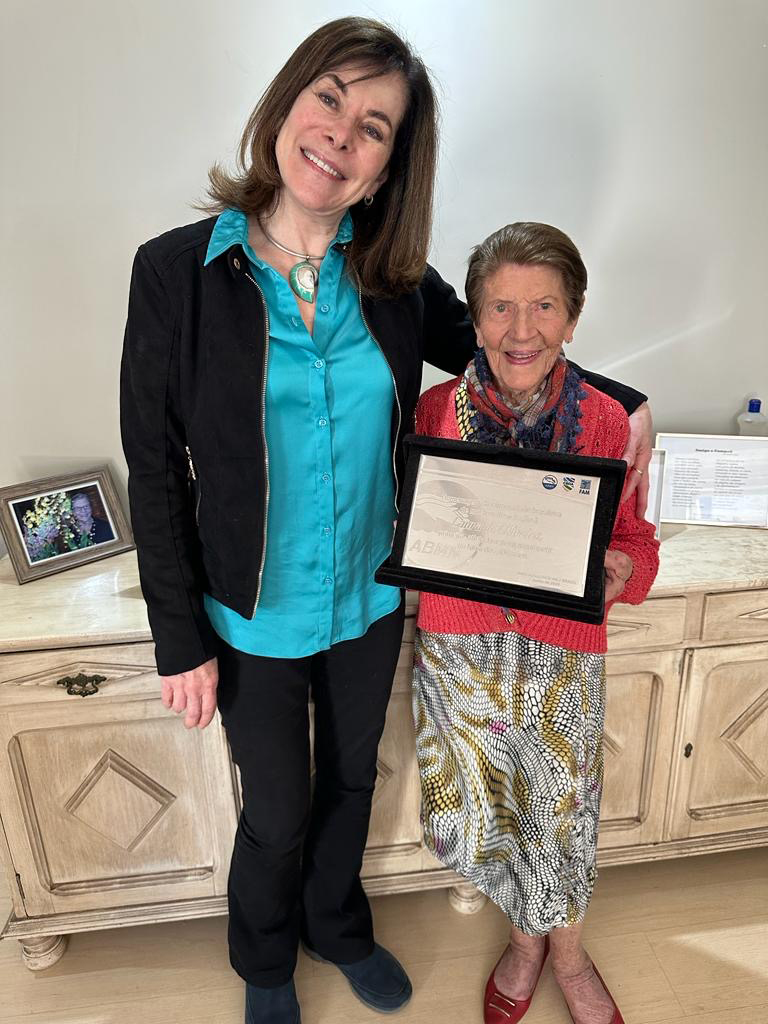
Mayana Zatz and Laura, a 104-year-old swimming champion. Photo credit: Mayana Zatz (Genomic Press).

Beach at Barra de Lagoa, Santa Catarina Island, Brazil. Photo credit: Adam Jones (Flickr), CC BY 2.0.
Insights from Brazilian supercentenarians
Brazilian research team investigates protective factors in extraordinary people who survived COVID-19 without vaccines and remained independent past age 110
The world's oldest living man is Brazilian. Born on October 5, 1912, he turned 113 last fall and remains part of an ongoing research study led by Dr. Mayana Zatz at the University of São Paulo. Her team has spent years tracking down, validating, and collecting biological samples from supercentenarians, the rare individuals who survive beyond 110, along with centenarians across Brazil's vast and diverse territory.
"This gap is especially limiting in longevity research, where admixed supercentenarians may harbor unique protective variants invisible in more genetically homogeneous populations," explains Mateus Vidigal de Castro, the study's first author and a researcher at the Human Genome and Stem Cell Research Center in São Paulo. The findings appear today in a Viewpoint article published in Genomic Psychiatry.
The numbers alone are striking. Three of the ten longest-lived validated male supercentenarians in world history are Brazilian. Among women, Brazilian supercentenarians in the top fifteen worldwide outnumber those from the United States, despite America's larger population and greater wealth. These statistics hint at something remarkable happening in a country not typically associated with exceptional longevity.
Brazil's secret may lie in its people's genetic makeup. Beginning with Portuguese colonization in 1500, followed by the forced migration of approximately four million enslaved Africans, and later waves of European and Japanese immigration, Brazil developed what scientists describe as the world's richest genetic diversity. A recent study identified more than eight million genomic variants in the Brazilian population that have never been described before, with over 36,000 potentially affecting health outcomes. Another investigation found more than 2,000 genetic insertions and over 140 immune system variants among elderly Brazilians that are completely absent from global genomic databases.
Why does this matter for understanding longevity? Most genetic studies of aging have focused on relatively homogeneous populations in Europe, Japan, and North America. The protective genetic variants that allow some people to reach extreme old age might be different. or entirely absent — in these populations. Brazil's unique genetic tapestry could harbor longevity secrets that scientists have simply never had the chance to find.
The research team has assembled a cohort unlike any other. Their longitudinal study includes more than 160 centenarians, with 20 validated supercentenarians distributed across multiple Brazilian regions with vastly different social, cultural, and environmental backgrounds. Among the participants was Sister Inah, a Catholic nun who was recognized as the oldest person in the world until her death on April 30, 2025, at age 116. The cohort also included the two oldest living men in the world: one died last November at 112, while the other, currently 113, continues to participate in the study.
What makes these individuals remarkable extends far beyond their age. At the time researchers first contacted them, some Brazilian supercentenarians were still lucid and independent in basic daily activities like feeding themselves. Many came from underserved regions with limited access to modern healthcare throughout their entire lives, providing scientists a rare opportunity to study resilience mechanisms that operate independently of medical intervention.
One family stands out with particular clarity. A 110-year-old woman in the cohort has nieces aged 100, 104, and 106 years old, representing one of the longest-lived families ever documented in Brazil. The eldest niece, now 106, was a swimming champion at age 100. This extraordinary clustering of longevity within a single family points strongly toward inherited factors that the researchers hope to identify through genomic analysis.
"Investigating such rare familial clusters offers a rare window into the polygenic inheritance of resilience and may help disentangle the genetic and epigenetic contributions to extreme longevity," notes Dr. de Castro. Previous research has shown that siblings of centenarians are five to seventeen times more likely to reach centenarian status themselves, reinforcing the heritable component of human longevity.
Perhaps the most dramatic demonstration of biological resilience in this cohort occurred during the COVID-19 pandemic. Three Brazilian supercentenarians in the study survived COVID-19 infections in 2020, before any vaccines existed. Laboratory tests revealed that these individuals, all over 110 years old. mounted robust immune responses against a novel pathogen that killed millions of much younger people worldwide. They produced high levels of protective antibodies along with immune proteins typically associated with effective viral defense.
How did individuals born before World War I manage to fight off a virus that overwhelmed the immune systems of people decades younger? The researchers believe the answer lies in understanding what makes supercentenarians biologically different from the rest of us.
Recent scientific discoveries have begun to reveal what sets these exceptional individuals apart. Their blood cells maintain protein-cleaning systems that function at levels comparable to much younger people. Their cellular recycling mechanisms. the processes that clear out damaged or malfunctioning components, remain active and effective. Single-cell analysis of their immune systems has revealed unusual populations of protective cells virtually absent in younger people, suggesting that supercentenarians don't simply age more slowly but actually develop unique biological adaptations.
A comprehensive genetic study of an American-Spanish supercentenarian who lived to 116 recently identified rare variants in genes controlling immune function, protein maintenance, and DNA repair. The Brazilian team believes their genetically diverse cohort may reveal additional protective variants that are invisible in more homogeneous populations, discoveries that could eventually benefit people of all backgrounds.
The immune system emerges as a central theme in extreme longevity research. Rather than viewing immune aging in supercentenarians as decline, scientists now see it as adaptation. These individuals show elevated levels of certain immune cells and develop unconventional but effective strategies for fighting infections and potentially even cancer cells late in life. Their survival through the COVID-19 pandemic offers dramatic real-world evidence of this resilient immunity in action.
Interestingly, the Brazilian supercentenarians report no particular dietary restrictions, unlike the American-Spanish supercentenarian who followed a Mediterranean diet. This diversity of lifestyles among the world's longest-lived people suggests that genetic factors may be more important than any single behavioral intervention, though researchers caution that much remains to be discovered.
Beyond genome sequencing, the Brazilian team is creating cell lines from selected participants for laboratory experiments and multi-layered biological analyses. Their goal extends beyond confirming what has been found in other populations. They aim to discover protective variants and mechanisms unique to Brazil's admixed population, findings that could inform precision medicine approaches relevant globally but particularly valuable for diverse populations that have been underrepresented in medical research.
In collaboration with Professor Ana Maria Caetano de Faria at the Federal University of Minas Gerais, the researchers will also investigate the detailed immune profiles of their cohort, seeking to understand exactly how these individuals maintained effective immune defenses into their eleventh and twelfth decades of life.
The implications extend well beyond academic interest. As populations worldwide grow older, understanding how some individuals maintain health and independence into extreme old age becomes increasingly urgent. Supercentenarians represent more than curiosities of human survival, they embody resistance, adaptability, and resilience, precisely the qualities that medical science must understand if the goal is not merely extending lifespan but improving quality of life for aging populations everywhere.
"International longevity and genomics consortia should expand recruitment to include ancestrally diverse and admixed populations, such as Brazil's, or provide financial support for genomic, immunological, and longitudinal studies that deepen scientific insight and enhance equity in global health research," states Dr. Mayana Zatz, the study's corresponding author and Professor at the University of São Paulo.
The call carries weight. Most large-scale genetic studies have focused on populations of European descent, creating blind spots that may have caused scientists to miss important discoveries. Brazil offers something no other country can match: extreme genetic diversity combined with validated supercentenarians willing to participate in research, some of whom have demonstrated remarkable biological resilience under real-world conditions.
Rather than merely surviving to extreme old age, these individuals actively resist the hallmarks of aging. Understanding how they accomplish this feat could reshape scientific understanding of human longevity and inform future interventions to extend healthy lifespan for everyone.
The peer-reviewed Viewpoint article "Insights from Brazilian supercentenarians" is freely available through Open Access at Genomic Psychiatry: https://doi.org/10.61373/gp026v.0009
ABOUT GENOMIC PSYCHIATRY: Genomic Psychiatry: Advancing Science from Genes to Society represents a paradigm shift in genetics journals by interweaving advances in genomics and genetics with progress across all areas of contemporary psychiatry. The journal publishes highest-quality medical research articles spanning the continuum from genes and molecules to neuroscience, clinical psychiatry, and public health.
Journal website: https://journals.genomicpress.com/
Genomic Press: https://genomicpress.com/
Genomic Press Media: https://media.genomicpress.com/
Ma-Li Wong
Genomic Press
mali.wong@genomicpress.com
Visit us on social media:
X
LinkedIn
Bluesky
Instagram
Facebook
Legal Disclaimer:
EIN Presswire provides this news content "as is" without warranty of any kind. We do not accept any responsibility or liability for the accuracy, content, images, videos, licenses, completeness, legality, or reliability of the information contained in this article. If you have any complaints or copyright issues related to this article, kindly contact the author above.
